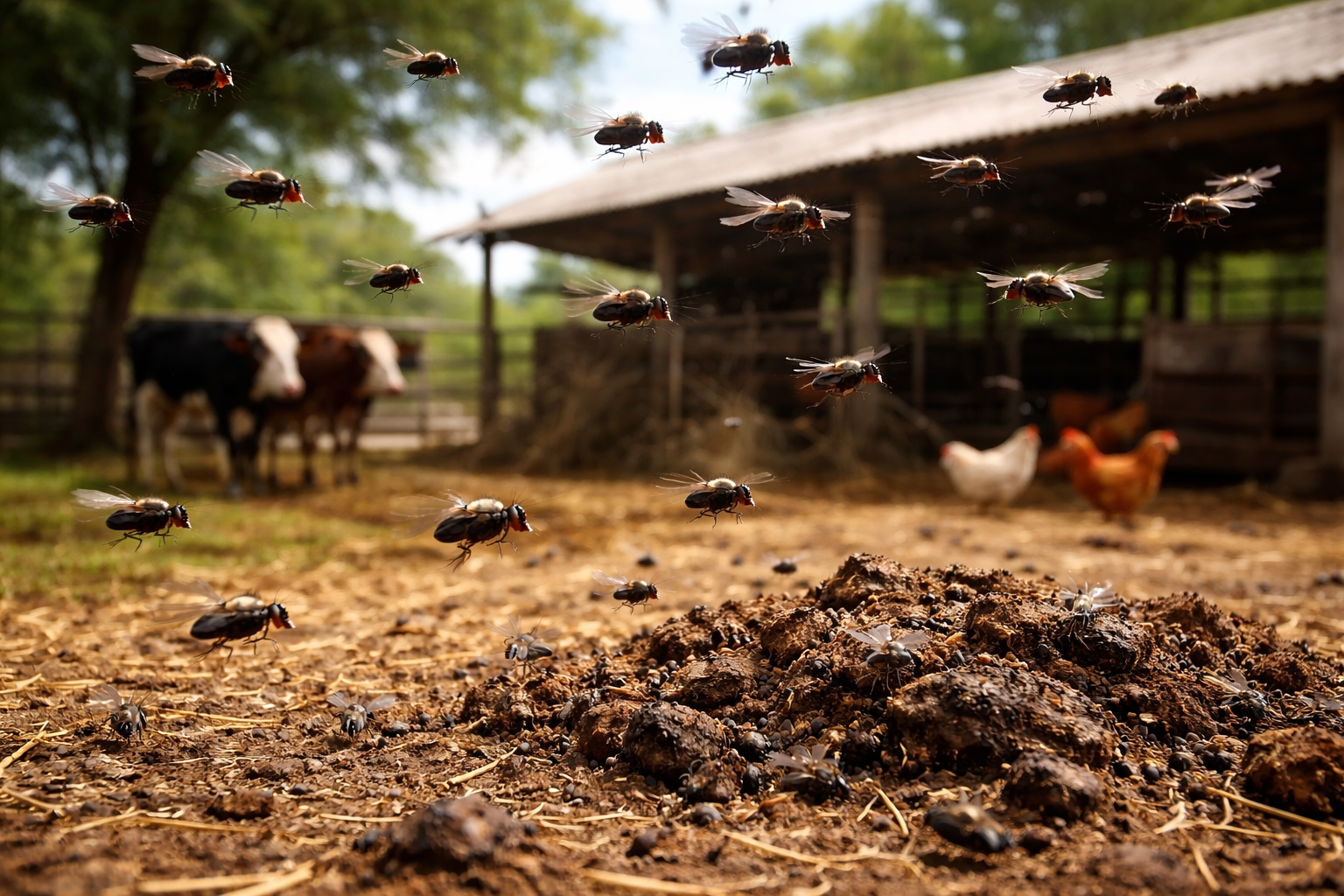
Why Fly Control Is a Modern Farming Priority
Flies are no longer a minor inconvenience in livestock farming; they are a serious economic, animal health, and welfare threat that directly affects farm performance. On poorly managed farms, high fly populations increase disease transmission, stress animals, reduce productivity, and raise operational costs.
Flies act as mechanical vectors for pathogens that cause mastitis, pinkeye, diarrhea, wound infections, and other production-limiting diseases. At the same time, constant irritation from biting and non-biting flies compromises animal welfare, leading to stress behaviors that negatively affect growth, reproduction, and overall performance.
The growing severity of fly pressure is closely linked to climate change. Rising average temperatures, increased humidity, and unpredictable rainfall patterns have created ideal conditions for fly breeding and survival.
In many regions, fly seasons are now longer and more intense, allowing multiple breeding cycles within a single year. This climate-driven expansion of fly populations has made traditional, seasonal fly control practices ineffective, forcing farmers to adopt year-round management strategies.
Fly problems are further amplified by the intensification of livestock production systems. As farms shift toward higher stocking densities to meet growing demand for animal products, manure accumulation, moisture buildup, and organic waste increase significantly.
Systems such as zero-grazing, feedlots, poultry houses, and intensive pig units concentrate animals in confined spaces, creating perfect breeding environments for flies if hygiene and housing design are inadequate. Without deliberate control measures, these systems experience faster fly population growth than extensive grazing systems.
The consequences of uncontrolled flies are measurable in farm output. Research and field data consistently show reductions in milk yield, slower weight gain, poorer feed conversion efficiency, and increased veterinary costs under high fly pressure. Blood-feeding flies reduce feeding time and cause energy loss, while stress from fly irritation suppresses immunity and productivity. Even modest fly infestations can lead to cumulative production losses that significantly affect farm profitability over time.
Because no single method can effectively address this complex challenge, modern livestock production relies on Integrated Fly Management (IFM). IFM is a science-based approach that combines sanitation, housing and environmental control, biological and mechanical methods, and strategic chemical use to disrupt the fly life cycle at multiple stages. Rather than reacting to fly outbreaks, IFM emphasizes prevention, consistency, and sustainability, making it more effective and cost-efficient in the long term.
We explore actionable, evidence-based fly control solutions tailored to different farming contexts. Smallholder farmers will find low-cost, practical strategies that fit resource-limited systems, while commercial producers will gain insights into scalable, technology-driven approaches. Students and agri-entrepreneurs will benefit from a clear understanding of fly control as a core component of modern, climate-smart livestock management. Together, these strategies position fly control not as a routine chore, but as a critical pillar of productive, welfare-focused, and future-ready farming.
Understanding Farm Flies: Species, Life Cycle, and Behavior
Effective fly control begins with understanding which flies are present, how they reproduce, and why livestock farms naturally support their survival. Applying control measures without this knowledge often leads to wasted effort, chemical resistance, and recurring infestations.
A science-based approach focuses on disrupting the fly life cycle and removing the environmental conditions that allow populations to explode.
Common Fly Species Affecting Livestock
Several fly species commonly affect livestock, each with unique behaviors and impacts on animal health and productivity.
House flies are the most widespread and are closely associated with manure, waste feed, and dirty housing. Although they do not bite, house flies are major mechanical vectors of disease-causing organisms. They readily move between manure, animals, feed, and water, spreading bacteria responsible for mastitis, diarrhea, and food contamination.
Stable flies are biting flies that feed on blood, primarily targeting the legs and lower body of cattle and other livestock. Even small numbers of stable flies cause significant irritation, leading to stamping, tail switching, reduced grazing or feeding time, and noticeable production losses. Stable flies are strongly associated with wet organic matter such as manure mixed with bedding or spilled feed.
Horn flies spend most of their adult life on cattle, feeding repeatedly on blood. Because they remain on the animal almost continuously, horn flies cause chronic stress, blood loss, and reduced weight gain and milk production. Heavy infestations are common in cattle systems with inadequate manure and pasture management.
Face flies cluster around the eyes, nose, and mouth of livestock. While they do not bite, they are a major contributor to the spread of eye infections such as pinkeye. Their behavior makes them difficult to control with conventional sprays, increasing the importance of preventive management strategies.
Blowflies are particularly dangerous due to their role in fly strike, especially in sheep, goats, and wounded animals. They lay eggs on soiled hair, open wounds, or moist skin, where larvae feed on living tissue. Fly strike is a severe animal welfare issue and can quickly become fatal if not treated promptly.
Fly Life Cycle Explained
All flies develop through four stages: egg, larva, pupa, and adult. Adult flies lay eggs on moist organic material such as manure, bedding, or decomposing feed. These eggs hatch into larvae (maggots), which feed and grow rapidly before transforming into pupae. From the pupal stage, adult flies emerge and begin reproducing within days.
The most important principle in fly control is that targeting breeding sites is far more effective than killing adult flies. Adult flies are mobile and short-lived, but breeding sites continuously produce new generations. Eliminating or treating these sites interrupts the life cycle and dramatically reduces overall fly pressure.
Under warm and wet conditions, flies reproduce extremely fast. Some species can complete their entire life cycle in as little as 7 to 10 days, allowing populations to multiply exponentially during rainy or hot seasons. This rapid reproduction explains why delayed or reactive control measures often fail.
Why Farms Create Ideal Fly Environments
Livestock farms unintentionally provide all the conditions flies need to thrive. Manure accumulation is the primary driver, especially in confined and zero-grazing systems where waste builds up quickly. When manure is mixed with bedding or feed, it becomes an ideal breeding medium.
Moist bedding further accelerates fly development. Wet conditions allow eggs and larvae to survive and mature faster, particularly in poorly ventilated housing. Spilled feed adds nutrients that enhance larval growth, while poor drainage creates standing water and persistently damp areas.
Finally, inadequate ventilation increases humidity and temperature inside animal housing, creating microclimates that favor fly survival year-round. When these factors combine, even a small lapse in hygiene can trigger a rapid and difficult-to-control fly outbreak.
Understanding these biological and environmental drivers is essential for designing effective, long-term fly control strategies based on prevention rather than constant chemical intervention.

Your explanation is too long, very few people like reading. Be short and precise. Yaani summarize your explanation.make it in point form and conclude
Appreciated! Thanks for taking the time to review — some topics are indeed complex. In the future, we’ll add easy-to-follow formats wherever possible.