A Good Farm Is Not Always an Easy Farm to Find
Modern agriculture is becoming more competitive, connected, and customer-driven. Producing quality milk, eggs, livestock, animal feeds, crops, or agricultural services remains the foundation of a successful farm, but production alone may not be enough to support long-term business growth. Farmers must also find reliable markets, communicate clearly with customers, build trust, and make their businesses visible to people who may not already know them.
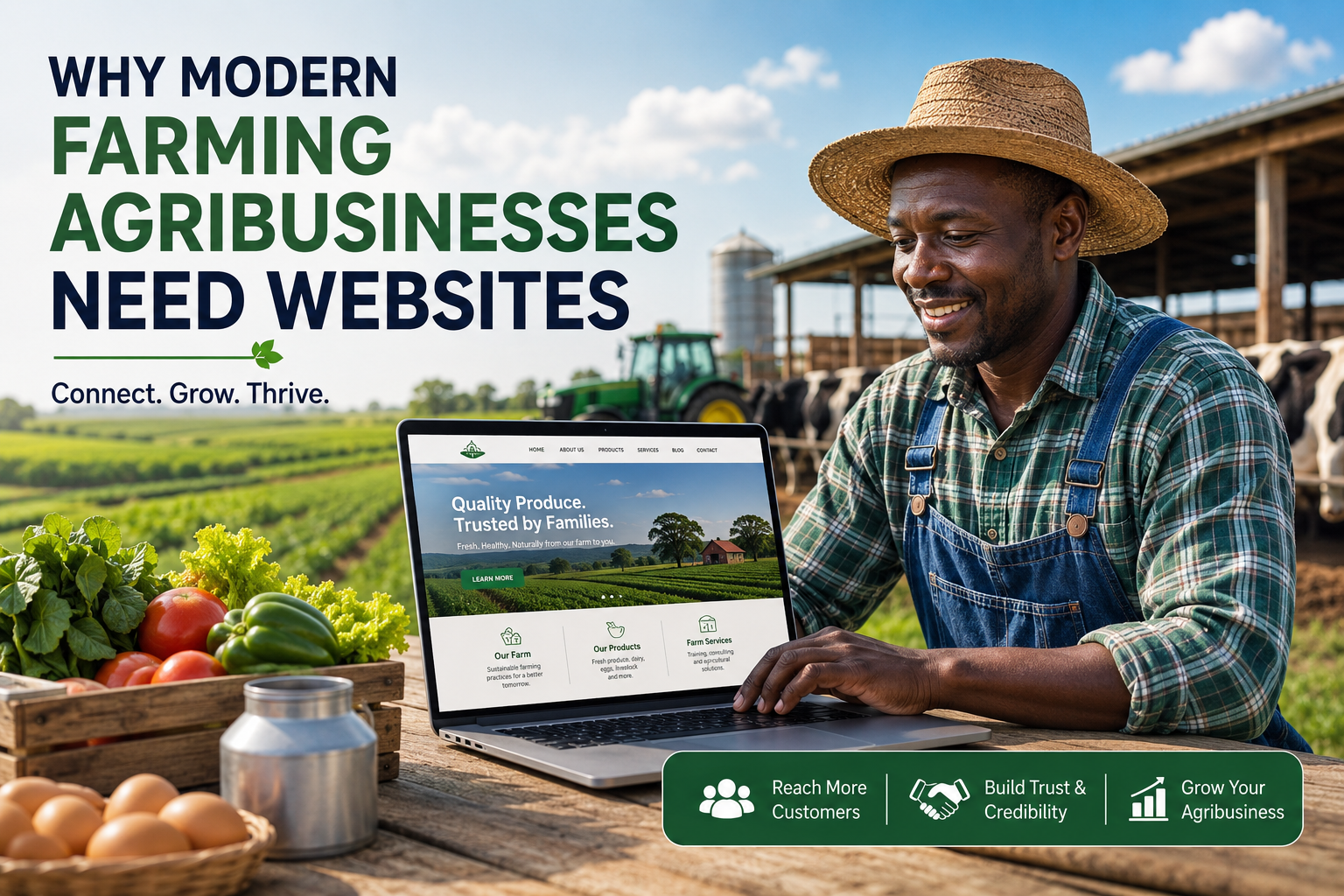
This is why modern farming agribusinesses need websites. A professional website provides a central digital space where farmers and agricultural businesses can present their products, explain their services, share their experience, and connect with potential customers. It allows a farm to remain visible even when the owner is occupied with feeding animals, supervising workers, managing production, or travelling to agricultural markets.
Many farmers have experienced situations where they have quality products but limited access to buyers. A dairy farmer may have enough milk during a high-production period but struggle to identify new customers quickly. A poultry farmer may receive repeated inquiries about egg availability, bird prices, or delivery services. A livestock breeder may depend mainly on referrals and local networks, even though farmers in other counties could be interested in the available animals. These challenges are not always caused by poor production. In many cases, the business is simply difficult for new customers to find.
A website helps address this visibility gap. It does not replace quality production, customer relationships, or traditional marketing. Instead, it gives the farm another way to reach customers and communicate its value.
Agriculture Is Becoming Increasingly Digital
The way people search for agricultural products and services has changed. Farmers, consumers, retailers, hotels, institutions, suppliers, investors, and agricultural organizations increasingly use smartphones and search engines to find information and identify potential business partners.
A customer looking for a reliable egg supplier may begin with an online search. A new dairy farmer may search for animal-feed suppliers or farm-management services. Someone interested in purchasing breeding stock may want to compare different farms before making contact. These customers may never visit a physical market until they have already researched available options online.
This shift has created new opportunities for agricultural businesses. A farm no longer has to depend entirely on customers who live nearby or people who have heard about the business through friends. A well-developed agricultural business website can introduce the farm to customers outside its immediate location and provide information before the first phone call or physical visit.
Digital agriculture is also changing how farmers access knowledge. Agricultural websites now provide production guides, livestock-management information, market updates, farm calculators, training resources, and technical content. As more agricultural activities move online, a strong digital presence is becoming an important part of business competitiveness.
A Website Makes Your Farm Easier to Find
A farm may produce excellent products and still remain unknown to potential customers. This is common when marketing depends only on word of mouth, roadside signs, physical markets, or personal networks.
Consider a dairy business that has developed a reputation for producing clean, quality milk. The farm may have loyal local customers, but a hotel, processor, or retailer in a nearby town may not know that the business exists. If the farm has a website optimized for relevant search terms, it has a better opportunity to appear when potential buyers search for fresh-milk suppliers or dairy businesses within the region.
The same principle applies to poultry farms, livestock breeders, feed suppliers, agricultural consultants, and farm-input businesses. A website can help customers discover a business through searches related to its products, services, location, or area of expertise.
Search engine optimization, commonly known as SEO, supports this process. SEO involves organizing website content so that search engines can understand what the business offers and when its pages may be relevant to a user’s search.
For example, a poultry enterprise can develop useful pages about its egg products, day-old chicks, broilers, or farmer-training services. A livestock-feed company can publish information about animal nutrition, feed products, and feeding practices. An agricultural consultancy can explain its services and the types of farms it supports.
The objective is not to repeat keywords excessively. The objective is to provide clear, accurate, and useful information that reflects what customers are genuinely searching for.
A Website Builds Trust Before the Customer Makes Contact
Trust is essential in agricultural business. Buyers want to know who they are dealing with, where products come from, whether a supplier is reliable, and whether the business can meet its commitments.
A professional website allows an agribusiness to answer these questions openly. It can explain the history of the farm, introduce the people behind the business, describe production practices, present available products, and provide accurate contact information.
For many customers, seeing real photographs of a farm, its facilities, products, and team creates a stronger impression than viewing an isolated advertisement. A detailed business profile can also help customers understand the scale and purpose of the enterprise.
For example, a livestock breeder can use a website to explain the breeds available, breeding objectives, animal-management practices, and customer support services. A feed manufacturer can describe its product range, quality-control systems, nutritional approach, and distribution network. These details help potential customers evaluate the business before making an inquiry.
Trust should be built through accuracy rather than exaggerated claims. A farm does not need to describe itself as the largest or best unless such claims can be verified. Clear information, genuine photographs, transparent communication, and reliable service often create stronger credibility.
Every Farm Has a Story Worth Sharing
Agricultural businesses are often built through years of work, learning, investment, and adaptation. Some farmers begin with a few animals and gradually expand their operations. Others transform family farms into commercial enterprises. Some identify a gap in the market and develop businesses around animal feeds, agricultural services, farm equipment, or farmer training.
These experiences are part of the farm’s identity, but they are often not communicated beyond the local community.
A website gives farmers an opportunity to tell the story behind the business. It can explain why the farm was established, how it has developed, what challenges have shaped its operations, and what values guide its work.
For example, a dairy enterprise that began with a small herd may have developed practical expertise in animal nutrition, breeding, and farm management over several years. Sharing this journey can help customers understand the experience behind the products. A poultry business that expanded from a small unit into a supplier of eggs and farmer-training services can use its story to demonstrate growth and commitment.
These stories should be integrated naturally into the business profile rather than written as promotional claims. The purpose is to give customers context and show the people, experience, and values behind the farm.
A Website Creates an Organized Market for Products and Services
Many farms offer more than one product or service. A dairy enterprise may produce milk while also selling breeding stock, manure, farm services, or farmer-training programs. A poultry business may provide eggs, chicks, birds, feeds, and technical support.
When all this information is shared only through social-media posts or messaging platforms, customers may struggle to find what they need. Older posts may become difficult to locate, and important details may be repeated across different conversations.
A website organizes products and services into clear sections. Each product can have its own page explaining its characteristics, availability, specifications, pricing approach, delivery options, and ordering process.
This can also help customers discover services they did not know the farm provided. A customer who visits a dairy farm’s website to learn about milk products may discover that the farm also provides training or sells breeding animals. The website creates opportunities for customers to explore the full range of business activities.
A Website Makes Customer Communication More Efficient
Farmers often receive the same questions repeatedly. Customers may ask about product prices, availability, farm location, delivery options, or ordering procedures. Responding to each inquiry individually can take time, especially when the farmer is managing daily production activities.
A website can provide this information in an organized way. Product pages can explain what is available, while a frequently asked questions section can address common concerns. Contact forms can allow customers to submit specific requests, and direct communication tools can connect visitors to the business through phone calls or WhatsApp.
This does not remove the need for personal communication. Agriculture is relationship-driven, and many customers still prefer direct conversations. The website simply makes the first stage of communication more efficient.
A customer can review the available information before making contact. This may result in more focused inquiries and reduce the time spent answering basic questions.
A Website Can Help Farms Reach Beyond Their Local Markets
Agricultural businesses are often located in rural areas, while many customers are based in towns and cities. A farm may have strong production capacity but limited access to urban consumers, retailers, hotels, schools, processors, or other institutions.
A website can help reduce this distance by making business information accessible from different locations.
For example, a farm in a rural county may supply customers in nearby towns but have the capacity to serve a wider market. Without an organized online presence, potential customers outside the local area may never learn about the farm. A website can present the business to these customers and provide information about products, production capacity, delivery arrangements, and contact procedures.
This can create opportunities for partnerships with retailers, wholesalers, institutions, processors, and agricultural organizations.
However, online visibility alone does not create a successful market. The farm must still maintain quality, reliable production, appropriate pricing, effective logistics, and good customer service. The website helps customers discover the business, but operational performance determines whether those relationships can be sustained.
Social Media and Websites Should Work Together
Social media has become an important marketing tool for farmers and agribusinesses. It allows businesses to share farm updates, publish photographs and videos, communicate with customers, and build communities.
However, social-media platforms should not be the only location where a business presents its information.
Important details can become difficult to find as more content is posted. Platform algorithms may affect how many people see a post, and changes to account policies may influence how businesses communicate with customers.
A website provides a more stable and organized digital home. It allows the farm to control how its products, services, stories, and contact information are presented.
Social media can introduce customers to the farm, while the website can provide complete information and guide visitors toward an inquiry or purchase.
For example, a farm may publish a short video showing its poultry-production activities on social media. Interested viewers can then visit the website to learn about available products, production practices, delivery services, and ordering procedures.
The two platforms are most effective when they support each other.
Websites Can Support Agricultural Sales Without Replacing Personal Relationships
Some agricultural businesses can use websites to sell products directly. Animal-feed suppliers, agro-input stores, seed companies, pet businesses, and sellers of packaged farm products may benefit from online product catalogues, ordering systems, payment options, and delivery information.
However, direct online sales are not appropriate for every agricultural product.
Livestock purchases may require farm visits, animal inspections, health records, transport arrangements, or discussions about production objectives. Large feed orders may require customized quotations. Agricultural consultancy services may require an initial assessment before a price can be provided.
A website can still support these transactions by allowing customers to request quotations, check availability, book consultations, or submit detailed inquiries.
The purpose is not to force every farm into an online-store model. The website should reflect how the business operates and make customer interactions more convenient.
Sharing Knowledge Can Strengthen an Agricultural Brand
Farmers and agricultural businesses often develop valuable knowledge through experience. They learn how to manage livestock, improve production, reduce losses, select inputs, organize farm records, and respond to changing conditions.
This knowledge can be shared through a website.
A dairy enterprise may publish articles about feed management, milk production, animal housing, or farm record keeping. A poultry business may provide information about housing preparation, chick management, feeding, or production planning. A feed company may develop practical resources on animal nutrition and feed efficiency.
Useful agricultural content can support farmers while also strengthening the business’s reputation.
When an agribusiness consistently provides accurate and practical information, it may become recognized as a reliable source of agricultural knowledge. Over time, this can support customer trust, website visibility, training opportunities, and business growth.
The content should be based on credible information and practical experience. Technical claims should be reviewed carefully, and specialized veterinary or regulatory guidance should be provided by qualified professionals where necessary.
A Website Helps Build a Recognizable Agricultural Brand
A website allows an agricultural business to communicate a consistent identity.
This includes the business name, logo, photographs, values, product information, and the message the farm wants customers to remember.
A strong agricultural brand does not depend only on attractive design. It depends on clarity.
Customers should be able to understand what the business produces, who it serves, and what makes it different.
For example, a livestock enterprise may focus on responsible breeding and farmer support. A dairy farm may emphasize consistent quality and reliable supply. A feed company may focus on nutritional quality and technical guidance.
The website can communicate these strengths consistently across product pages, educational articles, business profiles, and customer information.
Website Information Can Support Better Business Decisions
A website can provide useful information about customer interests.
Website analytics may show which products attract the most attention, which articles are frequently read, where visitors are located, and which pages generate customer inquiries.
For example, an agricultural business may discover that many visitors are searching for information about dairy-goat production. This may indicate an opportunity to develop additional educational content, introduce relevant products, or offer training services.
If a product page receives many visits but few inquiries, the business may review whether the information is clear, whether customers understand the ordering process, or whether the page needs stronger calls to action.
Website information should be considered alongside farm records, customer feedback, sales information, and market research. It is one source of business insight rather than a complete measure of performance.
What Should a Modern Farm Website Include?
A farm website does not need to be complex. Many small and growing agribusinesses can begin with a simple structure that clearly explains the business.
The homepage should introduce the farm, its main products or services, and the people it serves. The website should also include an “About Us” section that explains the farm’s background, experience, and values.
Product and service pages should provide clear descriptions and explain how customers can make inquiries or place orders. A contact page should include accurate phone numbers, email addresses, business locations, and communication options.
A blog or agricultural knowledge section can support farmer education and improve long-term search visibility. As the business grows, the website can be expanded to include online ordering, customer accounts, training platforms, farm calculators, and other digital tools.
The website should work well on mobile phones because many agricultural customers access information through smartphones. It should also load quickly, use clear navigation, and provide accurate information.
Small Farms Can Start with Simple Websites
Some farmers assume that websites are only useful for large agricultural companies. In reality, a small farm can begin with a simple website and expand over time.
The first version may focus on the farm’s story, products, location, and contact information. This can provide a professional foundation without requiring advanced features.
As the business develops, the website may include additional services, educational content, online sales, customer tools, or digital farm-management systems.
The most important question is not how large the website should be. The more important question is what business problem the website should solve.
For one farm, the priority may be finding new customers. For another, it may be organizing product information. A feed company may want to generate distributor inquiries, while an agricultural consultant may need a platform for presenting expertise and booking services.
The website should be designed around these practical needs.
The Future of Agricultural Websites
Agricultural websites are likely to become more interactive as digital technology develops.
Future platforms may include artificial intelligence-powered agricultural support, automated customer communication, online farmer training, smart farm dashboards, product-traceability systems, and digital agricultural marketplaces.
A livestock website may eventually allow farmers to calculate feed requirements, estimate production costs, access technical information, and connect with agricultural specialists through one platform.
However, technology should remain connected to real agricultural needs. The purpose of a modern farm website is not to add digital features simply because they are new. It is to improve access to information, markets, customers, services, and business opportunities.
Conclusion: A Website Helps Good Farms Become Visible
Many agricultural businesses already produce quality products and provide valuable services. Their challenge is not always production. Sometimes, the challenge is that potential customers cannot easily find the business or understand what it offers.
A website helps close this gap.
It can make an agribusiness easier to discover, help customers understand its products, build trust before the first contact, and create more organized opportunities for communication and sales.
A website does not replace good farming practices, reliable production, customer relationships, or sound business management. It strengthens these activities by giving the business a professional and accessible digital presence.
For farmers and agribusiness owners, the question is no longer only whether the farm is producing quality products. It is also whether the right customers can find the farm, understand its value, and contact it when they are ready to buy.
A professional, mobile-friendly, and SEO-optimized website can help make that connection possible.
Frequently Asked Questions
Why does a modern farm need a website?
A website helps a farm improve visibility, market products and services, build customer trust, provide business information, and generate new inquiries.
Can a small farm benefit from having a website?
Yes. A small farm can use a simple website to explain its products, share its story, provide contact information, and reach customers beyond its immediate community.
Is social media enough for an agribusiness?
Social media is useful for promotion and engagement, but a website provides greater control and allows the business to organize detailed information in one professional location.
Can a website help a farmer find customers?
An SEO-optimized website can help potential customers discover a farm through relevant online searches. It can also provide clear information and make it easier for customers to submit inquiries.
What should be included on a farm website?
A farm website should include information about the business, its products or services, location, contact details, production approach, and customer inquiry options. Useful agricultural content can also improve customer value and search visibility.
Can farmers sell products through a website?
Yes. Some farms can sell products directly through online stores, while others can use quotation requests, booking systems, or inquiry forms for products that require personal discussions.
Does a farm website need SEO?
SEO helps search engines understand the website and connect its content with people searching for relevant agricultural products, services, and information.
How long does it take for a farm website to produce results?
The timeline depends on the quality of the website, the level of competition, the usefulness of the content, SEO performance, marketing activity, and the farm’s ability to respond to customer inquiries. Website growth usually requires consistent improvement rather than immediate results.